
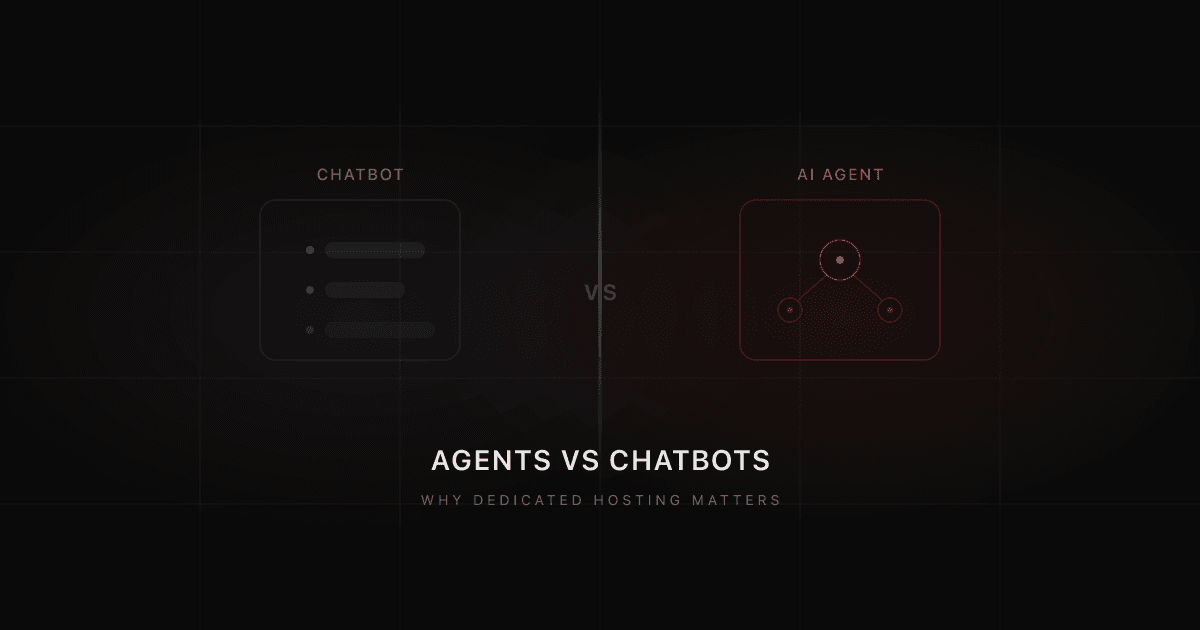
If you've used ChatGPT, Claude, or any AI assistant, you've interacted with a chatbot. But there's a new category of AI software that goes far beyond simple question-and-answer: AI agents.
While the terms are often used interchangeably, agents and chatbots are fundamentally different in their architecture, capabilities, and infrastructure needs. Understanding these differences is critical if you're planning to deploy AI in any serious capacity.
What is a Chatbot?
A chatbot is a conversational interface. You type a message, it generates a response. The interaction is essentially stateless — each conversation exists in isolation, and the chatbot has no ability to take actions beyond generating text.
Characteristics of chatbots:
- Reactive — They respond to prompts but don't initiate action
- Stateless — Each conversation starts fresh (or with limited context windows)
- Text-only — They generate text responses but can't interact with external systems
- Shared infrastructure — Typically run on multi-tenant servers where resources are shared across users
- Session-based — The "relationship" ends when the conversation closes
Chatbots are great for quick questions, brainstorming, and simple content generation. But they hit a wall when you need persistent, autonomous, action-taking AI.
What is an AI Agent?
An AI agent is an autonomous system that can perceive its environment, make decisions, and take actions to accomplish goals. Unlike chatbots, agents maintain state, use tools, and operate independently.
Characteristics of AI agents:
- Proactive — They can break down goals into subtasks and execute them autonomously
- Stateful — They remember past interactions, preferences, and accumulated knowledge
- Tool-using — They can browse the web, read/write files, call APIs, send messages, and interact with external services
- Dedicated infrastructure — They need their own resources to maintain state and run tools safely
- Persistent — They exist as long-running processes, not ephemeral sessions
An AI agent is less like a search engine and more like a junior employee — one that works 24/7, never forgets, and gets better at understanding your needs over time.
The Comparison
Here's how they stack up across the dimensions that matter:
| Dimension | Chatbot | AI Agent |
|---|---|---|
| Interaction | Responds to prompts | Takes autonomous action |
| Memory | Limited context window | Persistent across sessions |
| Tools | None (text-only) | Web browsing, file management, APIs |
| State | Ephemeral | Persistent |
| Infrastructure | Shared/serverless | Dedicated VM |
| Availability | On-demand | Always running (24/7) |
| Security | Shared environment | Isolated instance |
| Customization | Prompt-level only | Deep configuration + tool access |
Why Shared Hosting Fails for AI Agents
This is the critical insight that most people miss. You can run a chatbot on shared infrastructure because each interaction is independent and disposable. AI agents are different — they need dedicated resources for several important reasons:
1. Persistent State
An AI agent accumulates knowledge, preferences, and context over time. This state needs to survive restarts, updates, and maintenance windows. Serverless functions and shared containers are ephemeral by design — they spin up, handle a request, and disappear. That's incompatible with an agent's need for persistent memory.
2. Security Isolation
Your AI agent handles sensitive data — your messages, your files, your API keys, your business context. On shared infrastructure, your data coexists with other users' data on the same physical or virtual machine. A vulnerability in the platform could expose your information.
With dedicated hosting, your agent runs in its own VM with its own network, its own filesystem, and its own security boundary. There's no shared attack surface.
3. Consistent Performance
Shared infrastructure means shared resources. When other users are busy, your agent slows down. This manifests as:
- Cold starts — Your agent takes seconds to wake up after periods of inactivity
- Throttling — CPU and memory limits kick in during peak usage
- Latency spikes — Network contention causes unpredictable response times
A dedicated VM guarantees consistent CPU, memory, and network bandwidth for your agent, regardless of what's happening elsewhere on the platform.
4. Tool Execution Safety
AI agents execute code and interact with external systems. This requires a sandboxed environment where tool execution can happen safely. Shared hosting environments typically restrict system-level operations — preventing your agent from doing useful work like file management, web browsing, and API calls.
Dedicated hosting provides the system-level access agents need while maintaining security through VM-level isolation.
How EZClaws Solves This
EZClaws was built specifically for this problem. When you deploy an OpenClaw agent through EZClaws, you get:
- Dedicated VM — Your own VM with guaranteed resources
- Automatic HTTPS — Every instance gets its own subdomain on
ezclaws.comwith automatic SSL via Cloudflare Tunnel. No certificates to manage. - Cloudflare Protection — Enterprise-grade Cloudflare DDoS protection, global edge network, and secure tunneling built in.
- One-click deployment — The entire setup — VM provisioning, Docker configuration, DNS records, SSL certificates, tunnel creation — happens automatically in under 60 seconds.
- Real-time dashboard — Monitor your agent's health, view deployment status, and manage your instance from a simple web interface.
The infrastructure that would take hours to set up manually happens in seconds.
When to Use a Chatbot vs an Agent
Use a chatbot when:
- You need quick, one-off answers
- The interaction is conversational and doesn't require action
- You don't need persistence between sessions
- You're comfortable with shared infrastructure
Use an AI agent when:
- You need autonomous task execution
- You want persistent memory across sessions
- Your agent needs to interact with external tools and services
- Security and data isolation are important
- You need consistent, always-on availability
Most businesses and power users will benefit from both — chatbots for casual interactions, and agents for serious, ongoing work.
Getting Started with AI Agents
If you're ready to move beyond chatbots and deploy your own AI agent, the process is simpler than you think. EZClaws handles all the infrastructure complexity, so you can go from zero to a working agent in under a minute.
Read our step-by-step deployment guide to get started, or learn more about the OpenClaw framework powering it all.
Ready to deploy your own AI agent? Start your free trial with EZClaws — dedicated hosting, automatic HTTPS, and one-click deployment.
Your OpenClaw Agent is Waiting for you
Our provisioning engine is standing by to spin up your private OpenClaw instance — dedicated VM, HTTPS endpoint, and full autonomy in under a minute.